
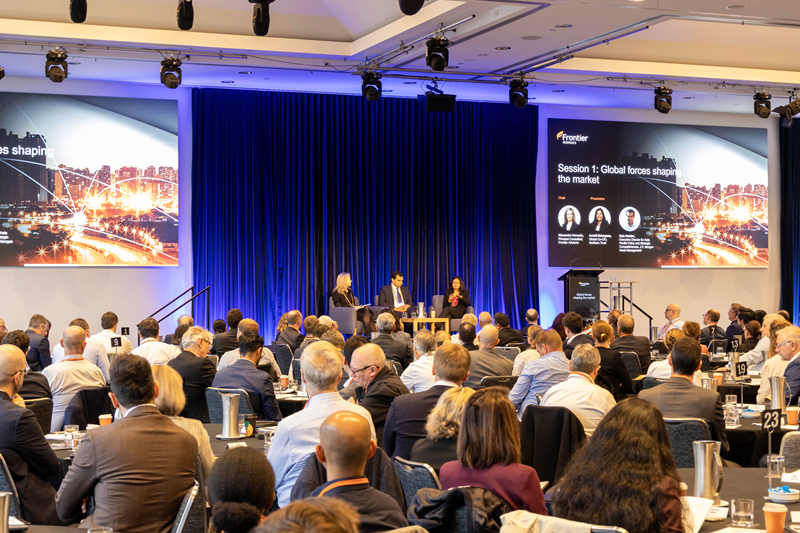
Geopolitical uncertainty has returned to peak post-Cold War levels while the economic fallout from the Iran conflict is set to continue reverberating across markets, according to speakers at our annual conference held in Melbourne on June 18. Nonetheless, markets remain optimistic hyperscalers’ massive AI investment will turbocharge productivity and transform the global economy – spending that one panellist warned could become a fundamental misallocation of capital. Speaking on the opening panel, Northern Trust Asset Management Global Co-CIO Anwiti Bahuguna put the probability of a US recession at 30 per cent – above the unconditional average of 15-20 per cent – due to geopolitical risk, elevated oil prices, and unresolved trade tensions. “Our team, at the moment, is of the mindset that there is an elevated risk of recession at 30 per cent,” she said. “At the same time, there is an immense amount of optimism in the markets around AI, the productivity it might envisage, and also the tax cuts the administration passed last year,” Anwiti said to a record audience of around 250 asset owners and industry participants. Anwiti said inflation remained persistently above the US Federal Reserve’s two per cent target across all measures and that central banks globally had shifted to rate-hiking cycles, although markets were ready to absorb another 50-70 basis points. “Beyond that, I think there is a risk that higher rates will start impacting cost of debt for companies, will start impacting housing, and will lead to retrenchment in consumer spending.” On the same panel, Kyle Hutzler, Executive Director for Asia Pacific Policy and Strategic Competitiveness at J.P. Morgan Asset Management, said measures of geopolitical uncertainty had returned to peak post-Cold War highs. He said the US-China relationship remains in a state of fragile stability after the recent Beijing summit, with both countries racing for self-sufficiency. Meanwhile, the fallout from the US-Iran conflict will have a significant impact across the Asia-Pacific. “Singapore’s Prime Minister Wong is right in saying that, in many respects, the worst is yet to come in terms of the secondary and tertiary consequences – for instance (but not limited to) agriculture, which again will be exacerbated by the El Nino dynamic.” US President Donald Trump and Iranian President Masoud Pezeshkian signed a memorandum of understanding on June 17, the day prior to the conference, establishing a 60-day ceasefire and reopening the Strait of Hormuz. However, in a separate panel, Tom Harley, Managing Director of political risk advisory firm Dragoman, said the destruction of facilities across the Gulf had been under-reported and its impact on inflation was being underestimated. “If I go to the terms of the agreement – some have described it as papering over cracks. I’d call it papering over a crevasse. It doesn’t resolve anything.” He told the conference China was the most likely strategic beneficiary in the wake of the US-Iran war, having maintained greater commodity self-reliance and deepened relationships with emerging economies.
AI: the next industrial revolution or bubble?
In a separate session, GQG Partners Chairman and CIO Rajiv Jain warned the AI boom will end as hyperscalers continue to pour hundreds of billions of dollars of capex into the buildout. He warned that the circular nature of investment flows between hyperscalers, frontier model companies and chipmakers was masking fundamental weaknesses, even as their share prices continue to soar. “When the party’s on, you’ve got to dance,” he said. “Our view is you better stay close to the door or leave early.” He pointed to OpenAI’s recently disclosed financials – US$13 billion in revenue against US$34 billion in losses – and said Nvidia had invested in more than 50 companies over the last six months, with the vast majority of them its own customers. “If the business is so good, why are you investing in your customers?” he said. Our Senior Consultant, Brad Purkis noted the AI-driven bull market had punished active managers who had underweighted the sector, with the median manager in Frontier’s global equity peer set trailing the benchmark by 4.9 per cent over the year to date. AI risks and opportunities were cited by the audience as the most important consideration for Australian asset owners in a poll which opened another panel. Almost one-third (32 per cent) cited that risk, followed by concentration risks (26 per cent) and the new inflation regime (24 per cent). AMP’s Chief Investment Officer, Anna Shelley, said it remained to be seen whether an uplift in productivity driven by AI would correlate with increased corporate profits. “I think that’s a very valid question and I have some doubts on that myself,” she said. In the same discussion, portfolio weightings toward China off the back technology and political development, and of emerging markets more broadly, drew attention. Our Director of Consulting, Kim Bowater, told delegates reduced weightings to emerging markets felt like “a growth opportunity that’s being missed” and a means to diversify away from US indices. Other sessions at our conference covered credit market risks, European real estate, Australia’s clean energy financing gap and the recent poor performance of Australian equity active management, as well as the merits of the total portfolio approach. Our CEO Andrew Polson also used his opening address to announce that Northern Trust had been appointed as custodian for the firm’s new independent chief investment officer (ICIO) service.
